


"Instead of firefighting and major repairs"
Relative shaft vibration is always measured with two, generally perpendicular distance sensors - arranged in a V-shape or horizontally and vertically - (eddy current displacement sensors). With this sensor arrangement, it is ensured that the motion of the shaft within the bearing can also be mapped. Therefore, the so-called kinetic orbit or orbit, the relative shaft position, shape error, and the full spectrum can be displayed. In the following, we explain these basic concepts.
Display options Kinetic orbit or orbit The calculation of the kinetic orbit is done from the simultaneous recording of two distance sensors placed perpendicular to each other (generally horizontally and vertically) in the manner detailed in the diagram.
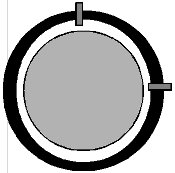
s1, s2 = instantaneous values s01, s02 = minimum values su1, su2 = maximum values sm1, sm2 = maximum values spp1, spp2 = vibration amplitudes sk = instantaneous shaft displacement smax = maximum shaft displacement K = kinetic orbit t = time The orbit can be generated from the complete, unfiltered time signal (waveform) and filtered, vectorial values. In vectorial representation, it is possible to depict rotational, double rotational, and triple rotational components separately and together. The unfiltered and combined vectorial orbits generally should show strong similarity. If not, either fractional harmonic vibration components are present, or the examined shaft surface is highly uneven.
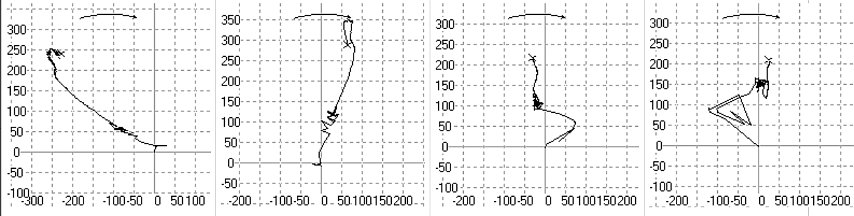
Shaft position, shaft runout The shaft position shows the relative position of the shaft's current average (theoretical) rotation axis. It provides extremely valuable diagnostic information about the shaft position rise and its changes during machine operation.
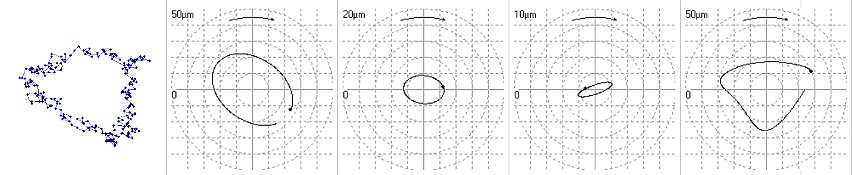
Shape error (slow roll) The slow roll is the orbit measured at low speeds - such as in turbine shafts operating in rotating mode - which can also be generated from unfiltered time signals or filtered, vectorial shaft vibration data. The slow roll practically shows the unevenness of the measured surface, the shaft's geometric (shape) error, and conclusions can be drawn about shaft curvature, shaft misalignment, shaft cracking, etc. It plays an extremely important role in evaluating operational shaft vibration data, as it can significantly influence our opinion about the machine's condition if we compensate the operational shaft vibration data with the slow roll vector. It is not uncommon to measure exceptionally high shaft vibration values at operational speeds or observe strong distortion in the orbits, leading to significant - potentially demanding machine shutdown - faults. However, after compensating for the large geometric error of the measured shaft surface (e.g., ovality) with slow roll, the shaft vibrations decrease to acceptable (even good) levels, and the strong distortion in the orbit disappears.
Allowable relative shaft vibration values
Important diagnostic information can be obtained from the shape of the orbit, revealing imbalance, bearing lubrication issues, rubbing, radial preloading of the shaft (shaft misalignment), increased bearing clearance, and other loosenings, shaft cracking, etc. Besides the analysis and diagnostic information, relative shaft vibration measurement can also be crucial for machine protection. The extreme limit of the shaft motion is, of course, the bearing clearance, and the allowable maximum relative shaft vibration must be smaller than this. Standards define the allowable levels of relative shaft vibrations. Some standards evaluate the vector sum of the two sensor signals, known as smax, while other (American) standards compare the larger of the two signals to the values specified in the diagrams. These standards differentiate between "good," "acceptable," "needs improvement," and "unacceptable" categories, providing separate allowable levels based on the machine type and performance. Naturally, the acceptable levels vary depending on the speed.
As mentioned, the allowable shaft vibration values - similar to effective vibration velocity - are defined by standards specific to each machine type. For example, the allowable shaft vibration values for steam turbines fall into the following categories: "A" can be continuously operated without restrictions, "B" acceptable vibrations, no repair required at the moment, "C" continuous operation not recommended, prepare for machine repair.
Errors detectable by shaft vibration measurement
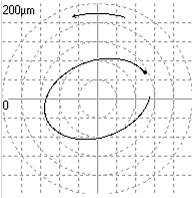
Imbalance Imbalance always leads to an increase in internal forces (centrifugal forces trying to displace the rotating part). The larger the imbalance, the greater the force trying to displace the rotating part from its rotation axis, resulting in a larger (rotational frequency) orbit in the journal bearing. Therefore, the larger the imbalance, the larger - usually a "nice" circular - orbit we get. If there is an opportunity for variable speed shaft vibration measurements and we have reference data about the machine's condition, then by comparing the rises (or falls), we can also infer the development of imbalance.
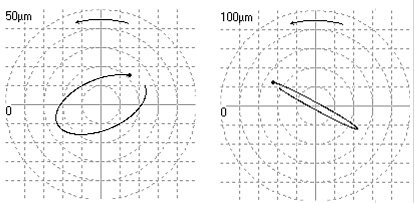
Shaft curvature In the case of a curved shaft during operation, we obtain a large and circular orbit seen at the unbalance, so there is no significant difference. However, if we have the opportunity for shutdown or startup inspection, in the case of shaft curvature, we will measure large shaft vibrations (actually shape defects) even at low speeds.
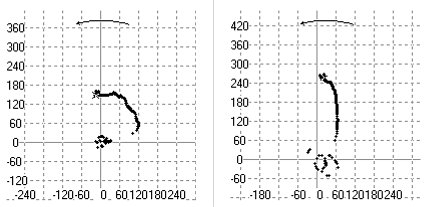
Single-axis error In the case of a single-axis error, the shaft is preloaded in the bearing, so both the change in relative shaft journal position measured during startup and the operational orbit of the shaft journal differ from the normal. During startup, the shaft journal moves too little or too much in one (sometimes both) directions. Normally, the vertical rise is about 30-40% of the bearing clearance. During operation, strong distortions also appear in the resulting orbit. (Note that for accurate evaluation of distortions, operational measurements must be compensated with the shape defect - the slow roll vector. ) If we have reference data (the actual shape defect of this shaft), then from the numerical values, we can precisely determine the required correction amount.
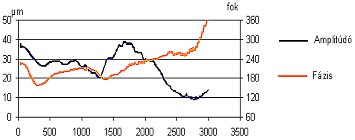
Resonance Resonance search should be carried out in the same way as discussed in the chapter on "traditional" (bearing-based) vibration measurement. Passing through resonance results in a significantly high amplitude value followed by an almost 180° phase shift.
Scuffing Contact between the rotating part and the stationary part can be point-like or circular. In the case of point-like contact, when the stationary part and the rotating part come into contact, the impact displaces the rotating part from its normal path, then another contact occurs, but at a different point, and so on. The consequence of all this is such a shaft vibration that fills the available space (bearing clearance) and results in a chaotic orbit. In the case of circular contact, a point on the rotating part due to an unbalance error scuffs against the stationary part in a circular manner. Due to scuffing, the shaft starts to heat up, thus becoming bent. The bent shaft changes its equilibrium state, another point will come into contact with the stationary part, thus heating up and bending elsewhere. Due to the described process, the location of the endpoint of the measured shaft vibration vector continuously changes over time during operation, and it can even rotate in a polar coordinate system.
Machine base faults If considering the measurement data compensated with the slow roll vector of the rotational frequency, and both the resonance frequency and the maximum resonance amplitude change, then primarily weakening of the machine base system, loosening of the suspension, or possibly - along with other signs - shaft cracking can be assumed. Generally, the start-up and shutdown of machines do not proceed in exactly the same way, but it is definitely worth comparing the start with the start and the run with the run. If there is no structural change or internal force change within the rotating machine, the dynamic vibration behavior (such as the values of resonance frequencies and damping) must be the same depending on the rotational speed. Changes in dynamic behavior can be most sensitively and accurately tracked through shaft vibration measurements, and these data can be monitored through Bode and polar diagrams. Oil whirl The most suitable method for detecting oil film faults is shaft vibration measurement. The fault and its nature can be clearly identified from the movement during shaft startup and run, as well as the motion measured during operation.
The extra effort pays off
In Hungarian vibration diagnostic practice, relative shaft vibration measurement has not yet become widespread, and we are still far from its general application. The reasons are quite obvious: on the one hand, the minimal instrument requirement for shaft vibration measurement is significantly higher (at least a simultaneous two-channel, but rather an 8-16 channel instrument is needed), and on the other hand, the implementation of the measurement is not so simple. It is not enough to attach the sensors to the bearing housing, but suitable mounts for attaching the sensors must be manufactured and installed, and the relatively small distance between the shaft and the sensor must be precisely adjusted. However, this extra work is very worthwhile in many cases, as the measurement can provide such reliable diagnostic information that cannot be obtained in any other way. Typically, such application areas are large rotating machines embedded with tilting pad bearings (steam and gas turbines, pumps). In the case of high-speed machines, for example, shaft vibration measurement complements bearing vibration measurement well because internal force changes occurring on the rotating part are only slightly visible on the bearing in the case of an elastic shaft and rigid bearing arrangement.
András Szűcs, Eric Rahne (PIM Ltd.) pim-kft.hu, gepszakerto.hu
The content of the publication is protected by copyright, and its (even partial) use, electronic or printed republishing is only permitted with the indication of the source and the author's name, as well as with the author's prior written permission. Violation of copyright (Copyright) will result in legal consequences.
Copyright © PIM Professzionális Ipari Méréstechnika Kft.
2026 | Minden jog fenntartva
Impresszum | Adatkezelés