


"Instead of firefighting and major repairs"
Expert systems are significantly more expensive on their own than "traditional" machine diagnostic systems based on vibration spectrum analysis. However, we must also be aware that the investment does not end with the purchase of the equipment system.
Proper operation and efficiency can only be achieved with expert systems if the system commissioning and operation are carried out with the appropriate expertise and technical content. This incurs costs, as shown in our table. It is undeniable that for many machines operating for long periods (preferably continuously) and requiring frequent measurements, expert offline systems pay off, and for even more machines, installed online systems pay off by reducing the engineering time-intensive measurement evaluation required for system operation. For technologies and machines operating rarely or periodically, not requiring detailed machine fault evaluation, the application of "traditional" vibration diagnostics is recommended.
Cost comparison among different diagnostic systems
Diagnostic costs for 3 years
| spectrum analysis | offline expert system | online expert system | |
| A) system acquisition (million HUF/system) - hardware - software - know-how | 1.5–5 0.5–3 0.5 | 3–5 4–7 1–2 | min. 4 min. 6 2–4 |
| B) commissioning (million HUF/system) - data upload (machine data) - baseline measurement (reference) - system "training" - system testing | 1 0.5 0 0 | 3 1–2 1–2 1–2 | 4 1–2 1–2 1–2 |
| C) system operation (million HUF/system) - conducting measurements (person) - measurement evaluation (engineering time) - system development, maintenance | 3 10 0 | 3 3–5 1–2 | 0 2–3 4–6 |
| 17–22 | 21–35 | min. 25 |
Advantages and limitations of expert systems
The undeniable advantage of expert systems is that they take into account a significantly larger number of machine fault vibration phenomena (orders of magnitude more than those shown in our previous tables and flowcharts) during data evaluation. Furthermore, thanks to modern computing technology, their speed surpasses that of any single "human" diagnostician. This advantage is most evident when evaluating a large number of machines at regular intervals (even "massively"). However, as a disadvantage, we must acknowledge that even with the most detailed database, we cannot expect the system to diagnose faults that can only be discovered based on the machine's history (construction, installation, commissioning) or unique behavior specific to the machine. It is also possible that visible faults remain invisible to the system. To illustrate this in practice, let's consider a very simple example: in the radial vibration velocity spectrum of a sliding bearing rotating machine, numerous harmonics can be found - a textbook example of mechanical looseness.

Our expert system tells us that we are most likely dealing with looseness. However, where is this looseness? Is there a gap between the shaft and the bearing sleeve, or perhaps between the bearing and the bearing housing? Are the screws securing the bearing cover or bearing housing loose? Has the baseplate separated from the base, or has the base cracked? What repairs should we prepare for? In our example, with a simple visual inspection (detecting cracks or leaked oil), we can easily solve the problem, find (or rule out) the fault.
Involving an Expert
In cases like this and similar ones, it is essential to involve an expert - knowledgeable in both diagnostics and machinery. While omitting the "human factor" aids in accurate analysis with expert systems, the diagnosis will only be correct and complete based on the input data and preparation. The system cannot consider operator or maintenance notes, as well as other - unregistered - circumstances. And one very important note: it is well known that there is no flawless software. Before making serious maintenance decisions, the probability and severity of faults indicated by the expert system must be verified by a "human" diagnostic expert. It is advisable to perform additional complementary measurements to prove the indicated problem. The most advanced expert software programs themselves recommend performing these additional measurements and thoroughly evaluating them.
Cost-effective alternative: fault recognition handheld tools
While the application of expert software (systems) is usually beneficial and cost-effective for operators of larger or cost-intensive machine fleets and technologies requiring frequent machine condition monitoring, this technology is currently out of reach for smaller companies due to investment and operating costs. However, due to the increasingly significant computing capabilities built into handheld tools, a new technology has emerged: there are now handheld tools available with built-in "expert capabilities." These handheld tools are essentially dialogue-based expert systems that do not rely on or contain detailed machine-specific databases. Therefore, they are only suitable for recognizing basic fault phenomena based on general correlations. Clearly, the "expert capabilities" of such tools cannot yet be compared to the capabilities of the PC-based expert software discussed earlier, but the development trend is promising. Below, we introduce one such fault recognition handheld tool that can assist machine operators without in-depth diagnostic knowledge. The compact tool, measuring only 105 mm×220 mm×35 mm and weighing 400 g, measures vibration, speed, and optionally temperature. It is capable of wideband vibration measurement according to ISO 10816, 3200-line spectrum analysis, demodulation, acceleration-based and L-type bearing analysis.
The uniqueness of the instrument is that it recognizes machine faults (and displays them in text) without the need for an external PC and software.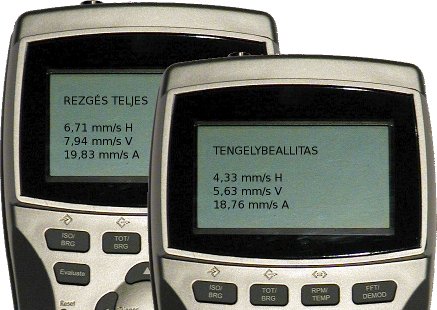
The result of the built-in automatic "expert" evaluation in the instrument is the textual (in Hungarian) display of the most likely machine fault (or faults). Its greatest advantage is that information regarding the presumed machine fault is immediately available during the measurement - next to the machine being examined. With such an instrument, even a trained - but lacking diagnostic experience - machine operator can quickly receive information about the condition of the examined rotating machine for organizing maintenance. All this without the need for external diagnosticians or "human" analysis of vibration spectra, at a very favorable price of approximately 1.2 million forints. It can be expected that numerous innovations will emerge in this field in the near future.
Summary conclusions It is clear from the above that expert systems can fit very well into the operation-maintenance system, but they must be applied in places and under circumstances where they are cost-effective and efficient. We should not expect miracles from them, and we must acknowledge that only the faults of those machine elements, machine components defined with appropriate care can be detected, and only those faults can be identified with high probability for which the necessary measurement data have been collected. Even for a vibration diagnostics expert - especially in the case of a large number of measurements - a well-defined expert system can provide significant assistance, as it does not tire, is fast, and free from subjectivity. Overall, when selecting an expert system, it is essential to consider that the selection, installation (establishment of the database) requires very serious machine and machine diagnostic knowledge, the responsibility is enormous, so it matters greatly who we entrust with all this. A poorly defined system, even if it costs tens of millions of forints, will never efficiently perform the tasks assigned to it in operation and maintenance. And above all, do not treat it as a miracle cure that can be used instead of experts - this will definitely end in failure.
Summary of advantages and disadvantages
Advantages
Disadvantages, pitfalls
Rahne Eric (PIM Ltd.) pim-kft.hu, gepszakerto.hu
The content of the publication is protected by copyright, and its (even partial) use, electronic or printed re-publication is only permitted with the indication of the source and the author's name, and with the prior written permission of the author. Violation of copyright (Copyright) will have legal consequences.
Copyright © PIM Professzionális Ipari Méréstechnika Kft.
2026 | Minden jog fenntartva
Impresszum | Adatkezelés