


"A universal measurement procedure"
Distributors of thermal imaging cameras and service providers creating thermal images often make serious professional errors in taking thermal images and selecting thermal cameras for the task. Below we continue to share the most important information for selecting the task-dependent type of thermal camera
The geometric resolution of the thermal camera significantly influences the image quality, measurement accuracy, and even the applicability of the thermal camera for certain tasks. The parameter called IFOV (instantaneous field of view, smallest elemental viewing angle) specifies the viewing angle that is mapped with a unique sensor (pixel). For example, the value of 1.5 mrad indicates that each measurement point projected onto the object at a distance of 1 m has a diameter of 1.5 mm, at a distance of 2 m, the projected surface has a diameter of 3 mm, etc. (This should be imagined as the beam of a flashlight, which covers an increasingly larger circular surface depending on the distance.) It is important that the object being measured be at least three times (but at least twice) larger than the unique measuring surface projected at the given distance, otherwise the measurement spot may contain not only the surface of the object but also its background. Since averaging occurs within the measurement spot, due to the background temperature, the measurement result can be either lower or higher than the actual temperature of the object. The greater the temperature difference between the object and the background, the greater the measurement error will be.
Thinking in Different Dimensions
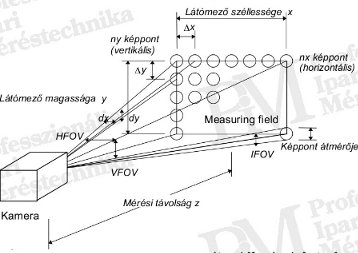
Naturally, the above rule applies not only to small objects (e.g., thin wires, filaments) but also when measuring large objects (e.g., large cross-sectional cables, windows). Obviously, we are talking about different dimensions: for small objects, we are dealing with measuring surfaces of millimeter size, which can be measured from distances of up to several tens of centimeters based on the geometric resolution capability of the applied thermal camera and optics; for large objects, we can talk about measuring surfaces of centimeter size being detected from distances of several meters (up to 10 - 100 m). However, in all cases, the use of equipment that allows compliance with the rule is necessary.
Since the geometric resolution always refers only to the optics currently in use, it is essential to check whether the optics mounted on the thermal camera meet the desired field of view and focal length. While some thermal cameras are available with interchangeable lenses or wide-angle and macro lens attachments, others (very rarely) can be ordered with additional zoom lenses. Moreover, the already mentioned scanning-type devices usually also have internal electro-optical zoom, which, while maintaining the size of the individual pixel, allows for image magnification.
Conclusions Regarding Geometric Resolution
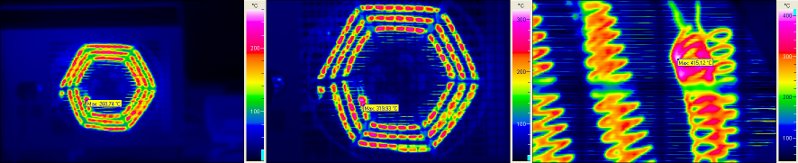
The combined geometric resolution of the thermal camera and optics sets a limit on how small the smallest measurable object can be from a given distance. Before each measurement, it must be verified whether at least two (but preferably three) elemental (projected) pixels actually fall on the smallest measurable object surface. If we do not have other (interchangeable) optics to meet this condition, the measurement distance must be reduced until this rule is met. Otherwise, significant measurement errors can be expected.
Thermal Camera Image Resolution
In addition to geometric resolution, the image quality achievable with a thermal camera, or more precisely the detail of the measurement, is determined by the resolution of the thermal camera, or in other words, the number of pixels. The reason for this is that for graphic recognition, a certain minimum number of pixels must fall on certain parts of the object surface – just as we are used to in digital photography. It is easy to understand that with more pixels, we can represent the object surface with greater detail or the same detail over a larger object surface in a single thermal image. If there are few pixels, many images need to be taken, and for the evaluation of continuous objects and the preparation of reports, image stitching often becomes necessary (which is a very time-consuming task). This issue is not insignificant for thermal cameras. While in digital cameras we talk about resolutions of 5, 6, 7, or even more than 10 megapixels (10 million pixels), in matrix thermal cameras, the number of pixels is typically 320×240 (thus 76,800) pixels. There are also cameras with lower capabilities (a common type is 160×120, with only 19,200 pixels), which can only display smaller surfaces with acceptable detail, which naturally strongly limits their area of application (in return, their price is very favorable). Thanks to the development of thermal camera sensors, more and more cameras with higher numbers of pixels are being produced. Cameras equipped with sensor matrices containing 384×288 elemental sensors are available at an acceptable price, and even devices with sensor matrices containing 640×480 pixels (with 50 or 60 Hz frame rates).
For Special Tasks
For special tasks, thermal cameras with even higher resolution matrices are being produced, which, with a small technical "trick," offer four times the pixel count of the built-in sensor matrix. By microscopically moving the lens system or optically deflecting the beam in other ways, they change the position of the beam projected onto the sensor matrix, so that radiation projected into the originally empty space between two elemental sensors (pixels) is also detected, and thus can be used for image formation. This method is naturally slower than the 50 Hz frame rate (it takes about 1 second to capture a four times higher resolution image), but it allows for the production of specifically high-resolution cameras (such as the Jenoptik VarioCAM research 780 type with 1.23 million pixels).With such devices, extremely detailed images can be taken even from very large surfaces (with fewer shots and without subsequent montage). However, the current selection of scanning (contact) thermal cameras is quite modest - practically this type is no longer available today (due to their slowness and expensive technology, fewer and fewer manufacturers produce such devices). The highest resolution of the last available models was 360×240 pixels. However, the advantage of cameras of this type was the perfect image homogeneity and high temperature resolution achievable with such cameras, as well as the possibility of real magnification (zoom). Conclusions regarding image resolution The number of pixels of the thermal camera influences how detailed a thermal image can be taken from a given surface. If greater detail is needed, the solution is to take more thermal images or use a higher resolution thermal camera. Of course, it must be considered what is more economical: the additional labor cost (taking many shots and montage) or the investment in a better quality thermal camera.
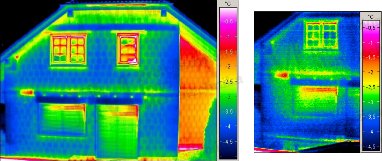
Examples of the effect of pixel count. Thermal image of a family house taken on the left with a professional camera (640×480 pixels, 80 mK temperature resolution), and on the right with a lower-capacity camera (120×160 pixels, 120 mK temperature resolution)
Effect of temperature resolution on image quality
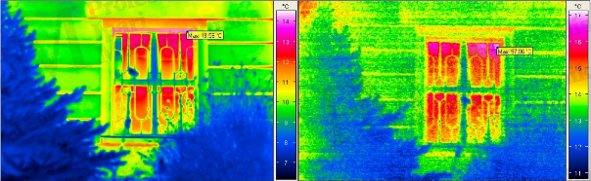
If the range to be measured falls between room temperature and the lower limit of the measurement range, the temperature resolution predominantly determines the image quality. NETD (noise equivalent temperature difference) represents the equivalent of the temperature change noise, which compares the effective value of the camera's own noise (usually measured at 30 degrees Celsius) to the temperature difference of the object. This value significantly increases as the temperature of the object decreases, especially in the case of short-wave devices. The temperature resolution capability of currently available thermal cameras primarily depends on the sensor technology. The most common matrix (long-wave) thermal cameras are mostly based on microbolometer sensors. Depending on the quality (and price) of the sensor used, this technology enables thermal resolutions of 120 mK, 80 mK, or even 30 mK, or 25 mK. The latter two values are achieved only by very high-quality devices, mostly through image averaging. Unfortunately, the resolution provided by manufacturers (e.g., 80 mK) for matrix cameras only applies to individual pixels. The double of this value (in our case 160 mK) applies to the entire image, as one pixel may be off by -80 mK while the adjacent one could reach +80 mK. However, some camera manufacturers additionally specify a parameter qualifying the resolution for the entire image (e.g., 100 mK), which documents better image quality than the provided temperature resolution data.
For long-wave scanning (contact) thermal cameras, the typical temperature resolution is 30 mK, and with image averaging it can be as low as 10 mK. However, this resolution applies to the entire image, as only one sensor is used. Furthermore, the image homogeneity resulting from the camera's operation further improves the quality, evaluability, and appearance of the thermal images produced.
The application decides
The temperature resolution limits the applicability of the camera in cases where detecting smaller temperature differences is necessary. Such tasks include building thermography (requiring a minimum resolution of 80 mK), medical applications (requiring at least 80, but preferably 30 mK resolution), or plant biology research (requiring a minimum of 30, but preferably 10 mK resolution). Of course, this list is not exhaustive. As a general rule, a device with at least two to three times better resolution than the smallest temperature difference to be displayed should be chosen. It is important to note that thermal resolution is not equal to the absolute measurement accuracy of the thermal camera. This value is usually ±1K or ±2 K. One reason for this is the technology of non-contact temperature measurement, as the thermal camera is a "floating level" measuring system, whose reference is determined by the internal reference surface (chopper) thermocouple and the Pt 100 resistance thermometer, and the other reason is the technical possibilities of camera calibration, as calibration is only done at a certain quantity (density) of reference points, so due to the non-linearity of the measuring system, it can only be guaranteed that the measurement accuracy remains within the above limits within a given measurement range.
Rahne Eric (PIM Kft.) pim-kft.hu, termokamera.hu
The content of the publication is protected by copyright, and its (even partial) use, electronic or printed re-publication is only allowed with the indication of the source and the author's name, and with the prior written permission of the author. Violation of copyright (Copyright) will have legal consequences.
Copyright © PIM Professzionális Ipari Méréstechnika Kft.
2026 | Minden jog fenntartva
Impresszum | Adatkezelés