ELEKTROnet 2003/4: ICP®: Piezoelectric Sensors with Built-in Amplifiers
Rahne Eric, B.Sc. in Electrical Engineering, founder of PIM Professional Industrial Measurement Technology Ltd., vibration diagnostics expert
Piezoelectric sensors based on the piezoelectric phenomenon (generation of electric charges due to force acting on the crystal) are widely used for measuring dynamic processes - such as acceleration, force, pressure. Their main advantages include: wide frequency range, large measurement range, and small size. However, the disadvantages of measurement setups using such sensors include frequent calibration needs, sensitivity to electromagnetic interference, cable length, and the quality of cables and connections. To address this, the American sensor manufacturer PCB developed and introduced sensors in ICP® design. ICP is a registered trademark of PCB and stands for "Integrated Circuit Piezoelectric," which translates to Hungarian as piezoelectric sensor with built-in amplifier.
Structure of ICP® Sensors The essence of the ICP
® design is that an amplifier, miniaturized thanks to modern microelectronics, is integrated into the housing of the piezoelectric sensor itself. This results in very simple and widely applicable sensors with the following main advantages:
- sensitivity independent of cable length and quality
- low impedance output (100 Ohm), making it suitable for wet and dirty conditions
- two-wire system, requiring coaxial or even traditional 2-core cables
- high output voltage (+/-5V or +/-10V), making it less sensitive to electromagnetic interference
- low output noise level
- wide frequency range
- simple self-test of the measurement setup possible
- easy power supply (from mains or battery), low cost per channel
- low calibration requirements
- evaluation and recording devices (recorders, oscilloscopes, etc.) can be easily connected
The design of the integrated amplifier in the sensor depends on whether the sensor element is ceramic-based or quartz-based. Quartz elements with low charge capacitance are capable of generating high voltages, so MOSFET voltage amplifiers are integrated into such sensors. On the other hand, ceramic sensors generate higher charges at lower voltages, hence charge amplifiers are used in these cases. The typical configurations are illustrated in the following diagram.
 |
| Internal structure of quartz-based piezoelectric sensor / Internal structure of ceramic-based piezoelectric sensor Figure 1: Typical structure of ICP® sensors for quartz and ceramic measuring elements |
Powering ICP® Sensors Measurement circuits containing ICP
® sensors typically consist of the sensor, the two-core connecting cable, and the sensor interface circuit (power-coupling unit), as shown in Figure 2.
 |
| Figure 2: Typical measurement circuit assembly for ICP® sensors |
The sensor interface circuit (power-coupling unit) consists of a constant current generator powered by a DC voltage (+18…+24V) and an interface (DC isolating) circuit. The meter labeled Vm, with high input impedance, indicates the voltage at the sensor output, typically ranging from +9…+12V DC in the quiescent state. The voltage measured by the meter in the sensor's quiescent state can also be used to functionally check the sensor and the connecting cable. The connection realized for ICP
® sensors is very immune to interference due to the relatively high signal levels, and it is advantageous that the current generator can drive long (shielded) cables, even in industrial environments.
Typical Range of Operation for ICP® Sensors The ICP
® sensor, as well as the constant current generator, is typically powered by a DC voltage between +18…+24V. Assuming a voltage drop of about 1V on the current generator and a quiescent voltage of 11V DC, with an 18V supply, the dynamic output range of the sensor is determined as follows: U signal = 18V - (1V + 11V) = 6V The sensor is unable to provide a higher distortion-free output voltage corresponding to a larger external physical signal, as its saturation becomes asymmetric. Increasing the supply voltage can help with this issue. The positive saturation capability of the above sensor is more than 10V with a +24V supply (with an unchanged 11V DC quiescent voltage). The negative saturation (in both cases) is also 10V. This relationship is illustrated in Figure 3.
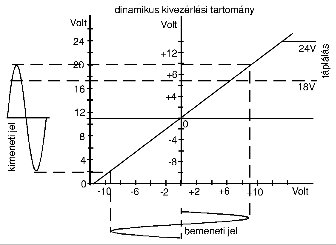 |
| Figure 3: Saturation range of ICP® sensors depending on the power supply |
For further information, please contact: PIM Professional Industrial Measurement Technology Ltd. H-1221 Budapest, Tanító u. 19/A Tel.: (1) 424-00-99 e-mail: pim@pim-kft.hu web: www.pim-kft.hu www.termokamera.hu www.gepszakerto.hu
The content of this publication is protected by copyright. Any (even partial) use, electronic or printed re-publication is permitted only with attribution to the source and author, and with the author's prior written consent. Violation of copyright (Copyright) will result in legal consequences.