


Physical Basis of Resonance
Mechanical structures exhibit different stiffness at different frequencies. At frequencies where the structure's stiffness is low (thus having a high tendency to vibrate), even very small forces can induce strong oscillations (vibrations) in the structure. These frequencies are called resonance frequencies, and the surrounding frequency range is referred to as the resonance range. The frequency range where the structure is characterized by high stiffness is called the anti-resonance range. Another important parameter is resonance damping. Damping measures how quickly the resonance vibration induced by a single excitation decays. Hard materials (such as glass, steel, brass) generally have low damping and continue to vibrate for a long time after excitation (an example of this in everyday life is a bell and a xylophone). The frequency range of such resonances is usually very narrow, with high amplitude peaks. Soft and plastic (elastic, soft) materials (such as rubber, wood) have high damping. These materials typically have a very wide frequency range of resonance, with lower amplitude peaks.
Resonance Issues in Rotating Machinery
From the perspective of industrial rotating machinery, it can be stated that every machine has one or more resonances due to the nature of the machine structure. The frequency range of resonances depends on the materials used and the design of the machine structure. Problems arise when one of the resonance frequencies coincides with the machine's rotational frequency or its multiples. For variable speed machines (such as DC or frequency-controlled asynchronous motors), this is where the issue arises: the wider the operational speed range, the higher the likelihood that the equipment may operate at a resonance frequency or one of its multiples. Resonance issues can be addressed through structural modifications (such as changing the natural frequency of structural elements, detuning the resonance frequency, or damping the resonance) and by changing the excitation frequency (by eliminating the machine fault, changing the operating speed, or altering the method of loading). However, before doing so, it is essential to confirm whether we are indeed dealing with resonance and to know its frequency.
Testing Methods
It is crucial to address resonance issues when minor changes in speed result in significant variations in vibration amplitudes (meaning that slight changes in excitation frequency lead to drastic changes in vibration magnitude). There are various methods for determining resonance frequency and resonance damping. Some methods require testing the stationary machine (impact excitation), while others utilize the variable frequency excitation occurring during the startup and shutdown of rotating machinery (based on the vibrations generated by the machine's rotation). In all cases, it is important to measure the response to excitation in multiple directions (e.g., horizontally and vertically) due to the spatial and directional dependency of resonances (significant differences, even orders of magnitude, can occur in different directions).
Impact Test
The simplest resonance test is the impact test, which is performed on a stationary machine. The essence of this test is to excite the machine structure with a single impact and record the spectrum of vibrations generated by the impact. Resonance frequencies appear as peaks in the spectrum, while anti-resonance ranges appear as valleys. The width of the peaks and valley-like ranges effectively characterizes damping. The frequency range that can be excited by impact depends on the duration of the impact impulse. In the 1/Τ frequency range, 90% of the energy transferred to the structure by the impact acts as vibration excitation. Therefore, soft (blunt) impacts, such as with a rubber mallet, can only excite vibrations up to a few hundred Hz, while short (hard) impacts, such as with a metal hammer, can induce vibrations in frequency ranges up to several kHz. For large structures and frequency ranges shifting towards higher frequencies, the impact test is less effective or not applicable due to the relationship mentioned above.
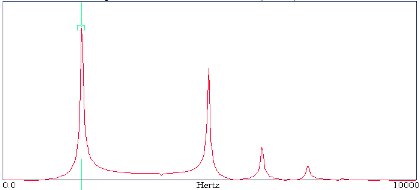
Figure showing a spectrum with four resonance frequencies recorded using an impact test [source: CSi]
Startup and Shutdown Tests
The methods detailed below utilize the variable frequency "natural" excitation occurring during the startup and shutdown of rotating machinery (vibration excitation resulting from the machine's rotation) to detect resonances. A drawback of these methods is that the excitation applied can also be a function of the rotational speed (consider imbalance: the centrifugal force inducing vibration increases proportionally with the square of the rotational speed). Peak-hold spectrum recording leverages the capability present in most instruments to average multiple spectra in a peak-hold manner (retaining the highest amplitude value associated with each frequency). Spectrums are continuously recorded and peak-hold averaged during machine shutdown or startup. As a result, a "blurred" spectrum is obtained, from which amplitude peaks below the operational frequency - indicative of resonances - can be identified.
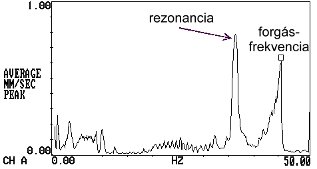
Figure: Peak-hold vibration spectrum from a machine shutdown (fan stop) [source: PIM]
Waterfall spectrum recording This method requires high-performance (high storage capacity and fast spectrum analysis capable) handheld instruments, as during the run or at set intervals, or depending on the speed (when reaching some fraction of the operating rotational frequency), a vibration spectrum must be recorded. These spectra are usually displayed consecutively, resulting in the so-called waterfall spectrum representation, which is a very illustrative form of visualization, making it easy to recognize all amplitude peaks.
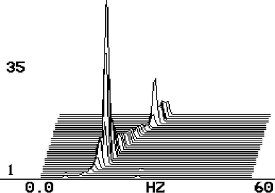
Figure: typical waterfall spectrum representation (electric motor start-up) [source: CSi]
Vibration amplitude and phase angle speed-dependent recording The basis is to continuously record the vibration amplitude at the rotational frequency and the corresponding phase angle during shutdown or start-up. By graphically representing these, not only the amplitude peaks become visible, but also the phase angle reversal occurring at the resonance frequency (thus a change of about 180°).
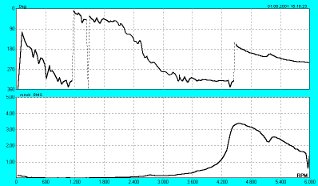
Figure: resonance at 4450 revolutions per minute determined by vibration amplitude and phase angle measurement [source: PIM]
Rahne Eric (PIM Ltd.) pim-kft.hu, gepszakerto.hu
The content of the publication is protected by copyright, and its (even partial) use, electronic or printed re-publication is only permitted with the indication of the source and author's name, as well as with the author's prior written permission. Violation of copyright will have legal consequences.
Copyright © PIM Professzionális Ipari Méréstechnika Kft.
2026 | Minden jog fenntartva
Impresszum | Adatkezelés