


"Instead of firefighting and major repairs"
It is undeniable that expert systems are the future of machine fault diagnostics. One reason for this is the often observed tendency to save on highly skilled labor. On the other hand, automatic diagnostic evaluation simplifies and speeds up vibration measurement, making the diagnostic result independent of subjective human judgment.
Along with information technology, devices and technologies for assessing the condition of rotating machinery have undergone significant development in recent years. Initially, devices measuring vibration levels were introduced, followed by portable broadband vibration data collectors. Their widespread use was primarily due to their simple application (such as not requiring specialized knowledge and having a "super simple" operation) and relatively low prices. Later, vibration analyzers (spectrum analyzers) and data collecting spectrum analyzer instruments began to spread. The diagnostic information that can be "read" from the data obtained with these devices (spectrums) is suitable for recognizing multiple machine faults, but it requires a technician with appropriate knowledge and experience.
Stages of Development
Interpreting and evaluating the data from spectrum analyzers is usually challenging, especially for beginners and occasional users lacking diagnostic experience. Virtually all companies developing machine diagnostic instruments and software have tried to help with this. One way is that the PC software accompanying these devices not only offers various graphical representations of measurement data but also performs certain numerical evaluations. Examples include the ratio of harmonic, non-harmonic, and subharmonic components in the recorded vibration, indication of the presence of different vibration component groups, and numerical listing of vibration peaks. A significant milestone was the addition of information to the list of vibration peaks indicating which numerically determinable fault frequency (such as rotation frequency, bearing fault frequency, blade frequency, gear frequency) or its multiple or sideband combination it corresponds to. Those struggling with "reading" spectra can immediately compile a text-number data set based on this, allowing conclusions to be drawn about present machine faults. However, the biggest problem with this method is that the typical frequencies of many machine faults are identical, making their separation based on tables or lists rarely feasible or very uncertain.
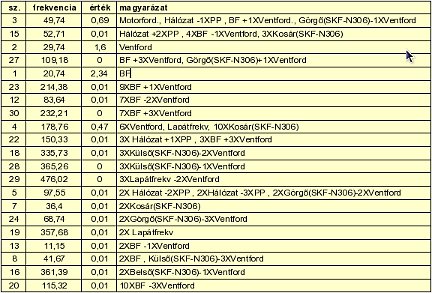
Machine Fault Diagnostic Systems
To address the mentioned shortcomings, PC software has appeared on the market (for example, from the American company CSi for over two decades) that perform vibration diagnostic signal processing and are capable of textually displaying the most probable machine faults using logical rules and statistical correlations. These evaluation systems are commonly referred to as automatic diagnostic or expert systems. In their case, machine diagnostic knowledge (more precisely, the logic of the diagnostic procedure and decision-making mechanisms) is practically built into the software. According to instrument manufacturers, the knowledge integrated into such systems is often deeper, more comprehensive, more diverse, and more logically structured than what anyone could acquire over many years. It is an undeniable fact that expert systems are the future. One reason for this is the often observed tendency to save on highly skilled labor. On the other hand, automatic diagnostic evaluation simplifies and speeds up vibration measurement and analysis (especially during the regular monitoring or continuous condition monitoring of a large number of machines), and even makes the diagnostic result independent of subjective human judgment. Based on these aspects and tendencies, the application and prevalence of expert systems are fully justified. However, there are pitfalls to their application, which we will draw attention to in the following.
Basic Concept of Machine Expert Systems
Expert systems are generally released as optional accessories to vibration diagnostic software, which is understandable since they primarily process vibration spectra. It is known that the most basic conclusions can be drawn based on the frequency peaks in the measured vibration signal. This is because most machine faults can be characterized by frequencies associated with specific faults (such as rotation frequency, bearing fault frequency, blade frequency, gear frequency) or their multiples or sideband combinations. For evaluation, it is only necessary to examine the spectrum of the vibration signal for frequencies related to the components in the machine and the likely machine faults – taking into account the current speed. The occurrence of frequency peaks suggests the presence of a fault, while the magnitude (amplitude) of the vibration indicates the extent of the fault.
Typical Vibration Frequencies for Common Faults
| Imbalance | 1 times rotation frequency |
| Shaft misalignment | 1, 2, 3, possibly 4 times rotation frequency |
| Looseness, mechanical play | 1, 2, 3, 4, 5, possibly 6, 7, 8, 9 times rotation frequency |
| Gear faults (gearwheel) | 1, 2, 3 times number of teeth × rotation frequency |
| Blade faults (fan, pump) | 1, 2, 3 times number of blades × rotation frequency |
| Belt frequency (belt drive) | calculated based on the geometrical dimensions of the pulleys, belt length, and rotation frequency |
| Roller bearing faults | calculated based on the bearing's geometrical dimensions and rotation frequency |
| Electric motor electrical faults | 2 times mains frequency |
When studying the above table, it becomes clear that there are errors that can be clearly identified, while others can only be diagnosed with a certain probability. Errors that can be clearly identified include those whose frequencies can be separated from other fault frequencies, such as oil film instabilities, gear drives, belt drives, and often faults in rolling bearings. Those that are difficult - or more difficult - to diagnose include errors in concentricity, looseness, mechanical play, and resonances - especially when they occur in certain combinations and with imbalance. The difficulty arises from the fact that errors inherently produce similar vibration spectra, and the vibrations they cause also depend on the machine's nonlinear behavior.
The speed of deterioration is important However, expert systems are expected not only to indicate the nature of the machine fault, but also to provide information on how quickly the machine's condition is changing. The rate of deterioration of the machine's condition is the most valuable information for organizing condition-based machine maintenance, as it allows estimating when and what intervention needs to be performed to ensure that the machine operates without unexpected shutdowns and unnecessary repairs, while also avoiding greater damage due to existing incipient faults. To achieve this, the trend of severity of machine faults must be established, with the rate of increase providing information on expected lifetimes. The basis and method of trend analysis is quite simple: at regular intervals, the machine's vibrations need to be measured again (at the same locations, in the same direction, and preferably with the same measuring equipment), and these data need to be analyzed with the expert system, evaluating the severity of identified faults graphically over time. By considering interpretable threshold values for current machine faults, it is possible to estimate how long the machine can still be operated under unchanged loads and other operating conditions, and when and how intervention should be carried out at the latest.
PC software and their operation Based on their interactive operation, we fundamentally distinguish between two types of expert systems: dialogue-based and feedback evaluation systems. In the case of dialogue-based expert systems, during the analysis of measurement data, the system operator (diagnostic expert, mechanical engineer, maintenance personnel, machine operator) must answer to assign the discovered fault phenomena to machine elements and faults, indicating which subunits and properties the examined machine has. In contrast, in feedback evaluation systems, the evaluation operates automatically without interactive dialogue with the expert, as the system uses all the information provided during the database creation. While only basic information needs to be input into the database to be prepared in advance in the case of dialogue-based systems - the rest will need to be provided during the analysis of measurements based on assumptions - constructing the database for feedback evaluation systems is a demanding task: decisions can only be made based on the information provided, and incorrect or missing data can lead to erroneous evaluations. The advantage of such inference-based systems is that the evaluation (expertise) can be fully automated based on a good database. Dialogue-based systems may have the advantage of quicker and more cost-effective implementation (smaller and simpler database), but the presence of a qualified operator during operation quickly offsets this advantage (not to mention having to answer the same questions repeatedly.) It is obvious that feedback systems better meet the expectations of our time, so we will focus on them in more detail in the following.
Rahne Eric (PIM Ltd.) pim-kft.hu, gepszakerto.hu
The content of the publication is protected by copyright, and its (even partial) use, electronic or printed further publication, is only permitted with the indication of the source and the author's name, and with the author's prior written permission. Violation of copyright (Copyright) will have legal consequences.
Copyright © PIM Professzionális Ipari Méréstechnika Kft.
2026 | Minden jog fenntartva
Impresszum | Adatkezelés