


"Instead of firefighting and major repairs"
Due to the structure and operation of electric rotating machines, not only mechanical forces and resulting vibrations occurring in the driven rotating parts are present, but also the forces arising from the electromagnetic fields can cause time- and direction-dependent stresses on individual machine elements - and thus can also cause mechanical deformation. In our article, we continue the examination of vibrations due to rotor faults, then we move on to analyzing stator faults.
The eccentricity of the rotor's electromagnetic field can arise from the rotor's eccentric geometry or from broken bars or end rings. In the following, we only deal with phenomena caused by the rotor's geometrical faults (broken bars or end rings were discussed in the previous part of our series). The geometrical eccentricity of the rotor can result from manufacturing inaccuracies or operational - mostly thermal - effects. Since rotor balancing usually occurs at the end of the manufacturing processes, in such cases, the mechanical (static and dynamic) unbalance caused by the rotor's eccentricity is not detectable because it has been compensated. Operational deformations - such as thermal deformations - can, however, cause unbalance, which is immediately noticeable through vibration peaks at frequencies characteristic of unbalance.
Rotor Eccentricity
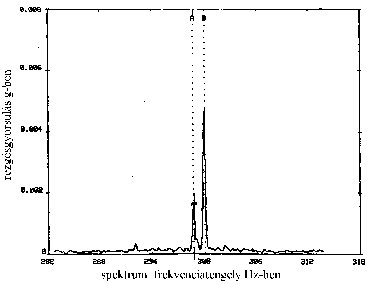
The geometrical eccentricity of the rotor always involves varying air gaps (the smallest and largest air gap rotates around the stator along with the rotor). This inevitably generates vibrations and causes periodic changes in the electromagnetic field strength. In case of rotor eccentricity, increased vibration amplitudes can be observed at twice the line frequency (and its multiples), or even at the line frequency itself. Furthermore, sideband vibrations occur around the rod frequency at twice the line frequency, as well as sidebands at the pole modulation frequency around twice the line frequency. The pole modulation frequency itself appears as low-frequency vibration.
It should be noted that eccentric rotors can also develop due to thermal deformations. In such cases, it can be observed that the vibration component at running speed continuously increases with operating time (as the motor heats up). In addition, vibration phenomena characteristic of a bent shaft (radial vibrations indicating unbalance with a stable phase angle, as well as axial vibrations showing a 180° phase difference) also occur, becoming stronger over time. In cases of misaligned shafts or "soft-foot" motors, variable air gaps can develop, which manifest similarly to rotor eccentricity.
About the rotor's electromagnetic eccentricity
According to the German VDI 3839 standard: A rotor eccentrically placed in the stator does not induce vibrations. Rotors constructed eccentrically cause vibrations characteristic of unbalance even with centric placement, as well as amplitude modulations at frequencies corresponding to the double slip frequency and the product of the line frequency. Floating currents also occur in the stator currents, with a frequency equal to the product of the double slip frequency and the line frequency. This periodic displacement can be observed on analog current meters and can be well displayed with oscilloscopes. If the motor's vibrations show amplitude modulation that is independent of the load, rotor eccentricity is likely present. (If this modulation depends on the load, broken rotor bars can be inferred with high probability.) According to the CSI Pocket Vibration Troubleshooter’s Guide: Signals showing low-frequency modulation indicate rotor problems causing eccentric electromagnetic fields. Vibrations at line frequency are characteristic of a bent or eccentric rotor. Low-amplitude axial vibrations occur in slightly bent rotors. High-amplitude axial vibrations indicate a rotor deviating from the ideal electromagnetic field, or an eccentric deformation of the rotor.
Vibrations in case of stator faults
The stator of asynchronous electric motors consists essentially of coils placed around the poles, with at least one coil per phase, stator teeth, and the laminated core. The design solutions vary greatly depending on the application requirements. The most common faults are coil short circuits (insulation problems), stator eccentricity, coil breaks (ruptures), and loose laminated core or core part.

Short circuits between coils and other components, as well as coil breaks (ruptures), mainly occur due to aging, operational vibration loads, other dynamic stresses, or electrical or thermal overload. Short circuits can be observed * within a pole pair * between different pole pairs * between poles and the laminated core. The eccentricity of the stator's electromagnetic field can arise from geometrical faults in the stator coils or their spatial arrangement, material quality issues (inhomogeneities), and mechanical or thermal deformation of the stator (resulting in different air gap sizes along the circumference). The electromagnetic eccentricity of the stator can result from manufacturing inaccuracies or operational failures (such as thermal effects, vibration loads).
In case of vibrations due to stator faults, high-amplitude radial vibrations at twice the line frequency indicate eccentricity, unbalanced phases, short-circuited coils, or loose iron core. Axial vibration is generally small, unless rotor problems are also present. In addition, sidebands at the pole modulation frequency appear around the running frequency and its multiples.
It is worth noting that in the case of bent bases or motors installed with "soft" feet, different air gap sizes can often be found along the circumference. As a result, error phenomena arising from the eccentricity of the stator also occur. Moreover, in the case of motors with incorrect shaft alignment or installed with a labile (soft) base, vibrations with unusually high values can occur at twice the mains frequency.
Diagnosing rod breaks with electrical phenomena

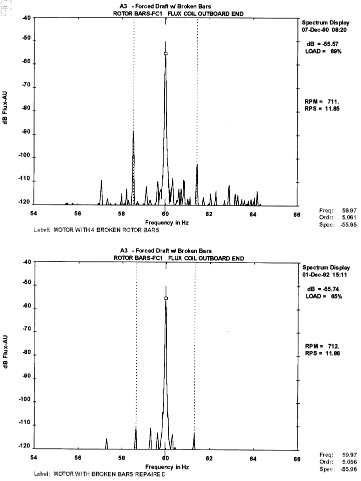
The most commonly used method for detecting breakages of the rotor bars, rings, or end rings is the phase-by-phase examination of current intake in the low-frequency range. The American company CSi recommends evaluating the magnetic field strength spectra recorded using a portable flux probe in addition to the current spectrum recording with a current clamp. In cases where current intake measurement is impossible or dangerous, flux measurement-based spectrum analysis is the only solution for recording electromagnetic phenomena.
To examine the current intake phase by phase, the current of each phase must be measured separately using a current clamp. A frequency analysis with high resolution should be performed around the mains frequency range. The amplitude ratio observed between the mains frequency and the sidebands with pole modulation frequency in the current spectrum provides information for fault detection. This ratio characterizes the extent of pulsation of the electromagnetic field per revolution. The limits for the amplitude ratio observed between the mains frequency and the sidebands with pole modulation frequency are provided in our table.
Technical Associates of Charlotte (current)
| Evaluation | Ratio | Comments |
| excellent | >60 dB | |
| good | 54–60 dB | |
| acceptable | 48–54 dB | trend monitoring recommended |
| warning | 42–48 dB | damaged rotor bar or high-resistance contact |
| alert I. | 36–42 dB | broken rotor bar or multiple high-resistance contacts |
| alert II. | 30–36 dB | multiple broken rotor bars, end rings, or contact faults |
| malfunction | severe faults (multiple at once) |
| CSI (current, or flux) | Mitchell (current) | |
| ok | >54 dB | >45 dB |
| warning | 54–45 dB | |
| alert | 45–40 dB | 35–45 dB |
Rahne Eric (PIM Ltd.) pim-ltd.com, machineryexpert.com
The content of this publication is protected by copyright. Any (even partial) use, electronic or printed republication is only permitted with the indication of the source and the author's name, as well as with the author's prior written permission. Violation of copyright (Copyright) will result in legal consequences.
Copyright © PIM Professzionális Ipari Méréstechnika Kft.
2026 | Minden jog fenntartva
Impresszum | Adatkezelés