


Eric Rahne, B.Sc. in Electrical Engineering, Level 3 Accredited Thermography Expert (PIM Ltd.)
Thermography is almost ubiquitous in every profession. We are currently experiencing the rapid spread of this contactless temperature measurement method, but also its most severe professional devaluation. Some thermal camera manufacturers and distributors have sunk to the level of labeling 80x60 pixel smartphone accessories without radiometric capabilities (and similar products) as professional thermal cameras (as if we were upgrading a VGA webcam to a professional video camera). Furthermore, it is disheartening that anyone who buys such a cheap device titles themselves as a thermographer without any professional training. Moreover, often without even basic knowledge (and consideration) of physics and metrology! With this series of articles starting now, we aim to provide insight into the incredible versatility and theoretical as well as practical limitations of thermography, drawing from Rahne Eric's 650-page specialized book titled "Thermography - Theory and Practical Measurement Technology."
Taking thermal images, or thermography, is an extremely versatile measurement method, while the user-friendly operation of modern thermal cameras can be compared to that of common digital video cameras. However, this simplicity should not deceive anyone: to capture correct thermal images from a measurement perspective, appropriate theoretical, professional knowledge, experience, and thorough measurement preparation are necessary. In the following, we detail the most important measurement requirements and practical knowledge of building structural and building services thermography examinations. For illustrative purposes, we also present the impact of some common thermal camera operator errors on the accuracy and credibility of measurements. Building thermography is perhaps one of the most widespread and well-known applications of thermography. At the same time, it is an area of examination that often yields results that are either inaccurately executed or completely incomprehensible due to errors. Based on theoretical considerations, we know that for measuring low temperatures, we should choose a long-wave thermal camera. This is good news for us, as thanks to the favorable transmission properties of the long-wave atmospheric window, we can detect thermal radiation almost "losslessly" from distances of hundreds of meters. Additionally, we can be pleased to choose a (micro-)bolometer thermal camera for our measurements (no need for an expensive photon detector device), as buildings do not move much.
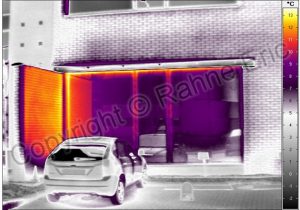
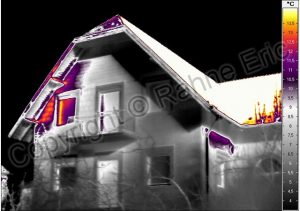
It is also favorable that typical building materials (except window glass and shiny metal surfaces) have relatively high emissivity. Since the temperatures of the objects to be measured typically differ only slightly from the ambient temperature, we only need to consider the effect of reflection to a small extent. This significantly simplifies matters for us in terms of specifying emissivity and ambient temperature, and allows for highly accurate measurements from the outset. (It is a different story with glass surfaces or aluminum-clad insulation, for example. These are difficult to measure, or - in the case of new/polished aluminum - cannot be measured at all.)
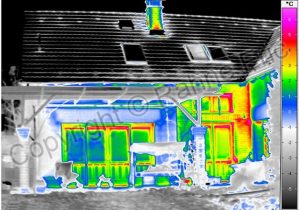
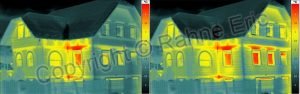
The primary goal of building thermography is the objective and comprehensive assessment of buildings, such as their thermal insulation. However, never forget that thermographic measurement serves to capture the momentary surface temperatures of objects, which are influenced by various measurement conditions. As a result, we must also expect measurement and/or evaluation limitations, which we will discuss in detail later. On a theoretical level, we distinguish between quantitative (numerical, quantitative) and qualitative (comparative, general) thermographic examinations.
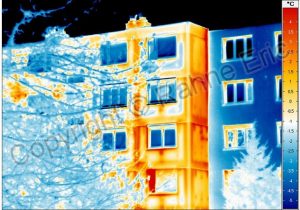
The purpose of quantitative inspection is to evaluate the complete surface thermal distribution of a building and determine the thermal conductivity coefficient (e.g., calculating heat loss or heating energy requirements). This can only be calculated based on very accurate (absolutely precise) temperature data recorded in a steady thermal state, so very strict conditions should be met in relation to the measurements. However, since there is never a steady state for free-standing buildings (due to temperature fluctuations between day and night), this measurement procedure can only be carried out under laboratory conditions at best. The purpose of qualitative thermal imaging building inspection is to reveal the hidden structure of building heat bridges and insulation defects (quality differences), as well as to search for and document building services anomalies. Most problems can be detected based on heat differences that are displayed with a thermal camera with sufficiently high temperature resolution. Adequate measurement conditions are also necessary for this, but absolute (numerically exact) temperature data and steady states play a minor role in this case.
In order to not only create beautiful colorful images with the thermal camera of the building to be inspected, but also to produce thermal images that can be evaluated by architects, energy experts, and the operator - allowing for correct conclusions - the following minimum requirements must be met: Time of outdoor recordings (time of day) Outdoor recordings should preferably be made in the late evening and early morning hours (during periods free from sunlight). The nature of the measurement task determines whether the "after-effects" of daytime sunlight are desirable for us (as it induces the desired physical condition to be exploited) or rather to be avoided (as it renders our measurement impossible by changing the temperature of the object being measured).
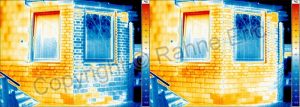
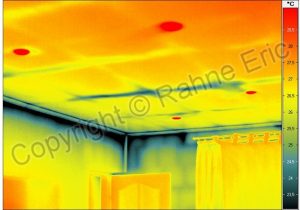
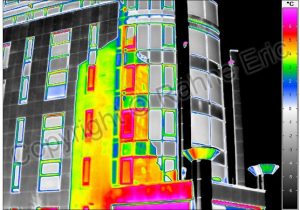
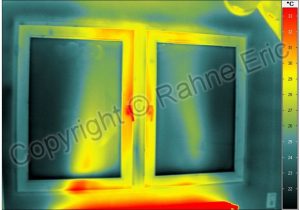
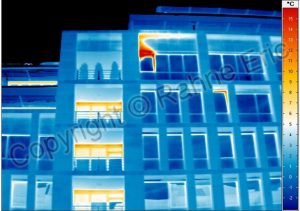
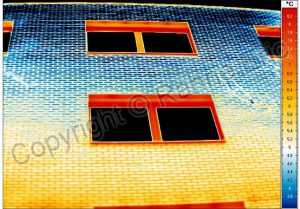
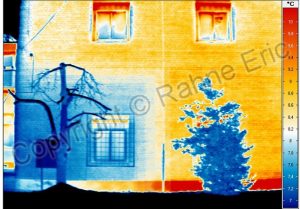
Weather conditions for outdoor recordings Dry weather and preferably calm winds (up to a gentle breeze <2 m/s) should prevail to prevent climatic conditions from affecting the condition of the building to be inspected. An exception is the detection of air sealing deficiencies, which (if we do not have a BlowerDoor device) generally lead to better results in strong winds (although in this case, it is more advisable to take indoor recordings). Seasons of building thermography Depending on the objectives of the inspection, there are typically measurement tasks related to the winter heating season (such as inspecting the thermal insulation of residential buildings), but there are also typical summer building thermography tasks (such as assessing the condition of refrigerated warehouses, checking air conditioning systems and cooling surfaces, as well as conducting certain structural moisture-related investigations). Indoor recordings Most inspections also require indoor measurements, the timing and feasibility of which often depend on external weather conditions (e.g., to ensure the necessary temperature difference for the inspection). However, sunlight, wind, and precipitation only indirectly affect indoor measurements. Therefore (compared to outdoor measurements), the timing constraints for indoor measurements are considerably more relaxed. It is often a requirement that the indoor environment is uniformly heated during and well before the measurement, with closed external openings. An exception is for pipe and leak detection, where it is preferable to start the hot water supply or heating in a cooled building to collect thermographic data during the necessary heating period for achieving the best results. Note: In some applications of building thermography, it may be permissible to deviate from the above measurement conditions (e.g., condition assessment of air conditioning in summer, searching for hidden structures, pipes, or moisture throughout the year). However, it is always essential that there is a sufficiently strong heat flow or temperature difference related to the properties of the object being measured. Heating, cooling, radiation (including sunlight), or other physical processes can be utilized for this purpose. However, it is important to be aware of the "side effects" of temperature-altering processes and their impact on the measurement for the accuracy of our evaluation.
The difficulties listed above unfortunately do not exhaust the list of challenges. The object being measured itself can also pose some headaches. This includes primarily the reflective properties of windows and glass facades, aluminum cladding, polished artificial stone surfaces, as well as the thermal independence of suspended building claddings and plinths from external walls, or their insulation. However, building coverings (trees, decorative elements, vehicles), the indiscipline of occupants (open tilt windows, sudden heating) can also hinder the accurate survey of buildings. Some of these cases can be observed in the images in the article. To be continued by Eric Rahne (PIM Ltd.) pim-kft.hu, termokamera.hu
The content of this publication is protected by copyright, and its (even partial) use, electronic or printed re-publication is only permitted with the indication of the source and the author's name, as well as with the author's prior written consent. Violation of copyright (Copyright) will have legal consequences.
Copyright © PIM Professzionális Ipari Méréstechnika Kft.
2026 | Minden jog fenntartva
Impresszum | Adatkezelés