


Eric Rahne, BSc in Electrical Engineering, Level 3 Accredited Thermography Expert (PIM Ltd.)
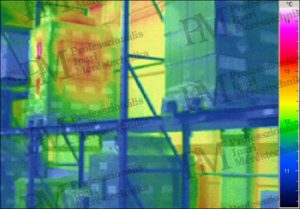
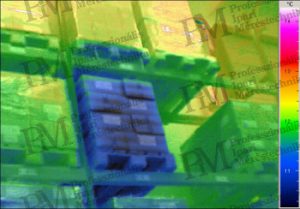
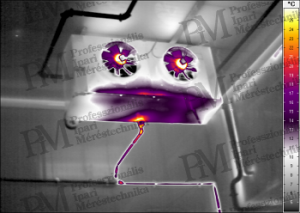
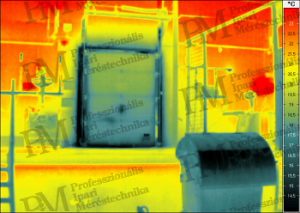
We have reached the final part of our thermography series. In this article, we will discuss the inspection of cold stores, refrigeration chambers, and other building components, as well as touch upon the thermal camera itself as a tool. Throughout our series, we aimed to provide insights into the incredible versatility and theoretical as well as practical limitations of thermography, drawing from Rahne Eric's 650-page specialized book "Thermography - Theory and Practical Measurement Techniques." The tasks of thermographic inspections in cold stores, refrigeration chambers, and of course refrigerated vehicles include revealing the thermal insulation capacity of the enclosing structure, walls, roof, floor, detecting the harmful effects of condensation water generated during cooling, assessing the condition of doors and mechanical systems, or even monitoring the cooling of stored products. Since the most critical operating conditions usually occur during the hottest period of the year, it is advisable to schedule inspections for the summer months.
The need to detect low temperatures, minimal temperature decreases caused by evaporating moisture, particularly requires a thermal camera with excellent thermal resolution, preferably with a measurement range starting from as low as -40°C. Phenomena and inspections achievable with thermography include:
Compared to thermographic tasks related to buildings, we need to highlight two particularities. It is crucial to provide the accurate ambient temperature at all times and the exact average temperature of the environment reflected by the surface being measured. We cannot rely on the generally valid small temperature differences in building thermography. Therefore, when conducting measurements, we must consider whether we are measuring from outside into a refrigeration chamber through its open door, where objects in the space behind us provide the ambient temperature, or if we are inside the chamber and the radiation reflected by the object is given by the cooled chamber wall.
The other peculiarity is related to the thermal camera used. Very few devices can be used at temperatures below -20°C. Most models have their lower operating temperature limit at -10°C. Therefore, it would be impossible to perform measurements in -35 ... -40°C refrigeration chambers. This issue can be circumvented by embedding the thermal camera in insulating material. The heat generated by its electronics during operation is sufficient to maintain the operating temperature, with only the uncalibrated lens cooling causing some measurement inaccuracies.
However, it is important to consider that the thermal camera cools far below outdoor temperatures when used inside a cold store/refrigeration chamber. If the cooled thermal camera is taken outside, its temperature will definitely be below the dew point. Therefore, we should expect a lot of condensation on the thermal camera, especially until it reaches the ambient temperature. To prevent this, place the thermal camera in an airtight bag even inside the refrigeration chamber. During warming up, it will only come into contact with the air inside this bag, which will continuously decrease in relative humidity as it warms up. Leaving the thermal camera on will speed up the warming process.
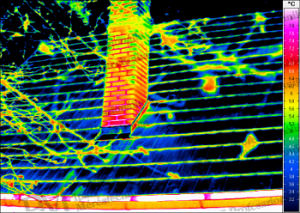
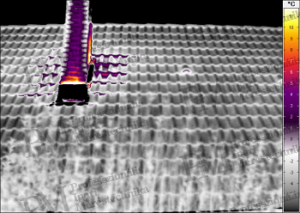
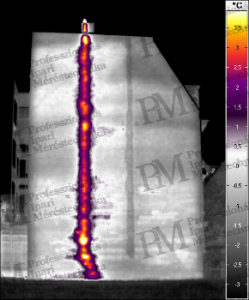
Naturally, there are many building elements whose inspection could fall under building thermography - just think of the diversity of industrial facilities. To conclude this section, we will briefly touch upon the chimneys of residential buildings and their roof integration with a few example shots. During thermographic inspection, the condition of the chimney structure, indirectly the density of the masonry, and the location of chimney flues hidden due to plastering in the building wall can be assessed. As shown in the example below, even straight chimneys standing on separate foundations in every country can tilt over time (even without earthquakes). (Or perhaps there may be deviations from the usual regulations?)
In the previous sections, we discussed what can be revealed using appropriate thermographic equipment in connection with buildings. It is time to precisely define what type of thermal camera and software are needed to carry out the mentioned surveys. We summarize this by listing the points. Wavelength range (spectral range) • long-wave range (8 ... 12 µm / 7 ... 14 µm) Note: Measuring low temperatures around 0°C outdoors with short- and medium-wave thermal cameras is almost impossible, as bodies at low temperatures do not emit or emit very minimal amounts of radiation at these wavelengths according to Planck's law. The long-wave spectral range also allows the use of favorable bolometric thermal cameras. Thermal camera type (sensor type) • matrix or scanning, raster Note: The thermal resolution and number of pixels of professional matrix thermal cameras and scanning cameras are both suitable. Choosing a matrix camera allows the use of bolometric sensors, which is currently the most economical solution. Measurement (calibration) range • min. -20°C ... 100°C, better -40°C ... 120°C Note: The lower limit of the calibration range is essential. Since the best images can be taken at night and at temperatures below 0°C, a thermal camera with sufficiently low noise value (NETD) is required even at low temperatures. As temperatures below -10°C may occur, it is advisable to choose a thermal camera with a calibration range starting from -20°C for safety. (Of course, cameras calibrated from -40°C provide even better image quality, as they have even lower noise levels.) Number of pixels • min. 320x240 pixels, better 384x288 or even 640x480 pixels Note: With a smaller number of pixels, only very small areas can be captured in each thermal image, for example, with 120x160 pixels, only a surface of 4 .. 5 m². Therefore, the necessary image stitching during data processing takes a lot of time and hides many sources of error. Geometric resolution • min. 1.5 mrad, better 1 mrad, but the best is the use of interchangeable wide-angle, standard, and telephoto lenses Note: In the case of worse geometric resolution, building thermal images would need to be taken from very close range to ensure that details, such as cracks or poor window-frame fits, do not "disappear." This would lead to many small-area shots that would then need to be painstakingly stitched together to create an understandable thermal image. For upper floors of panel buildings, the use of a telephoto lens is essential. Temperature resolution • min. 80 mK, better 50 mK, best 30 mK Note: In building thermography, excellent image quality is essential, requiring the best temperature resolution. Cameras with less than 80 mK are not suitable for detecting minimal temperature differences resulting from, for example, condensation or water ingress due to evaporative heat dissipation. The better the thermal resolution, the more opportunities we have for executing measurements, as even smaller heat flows and temperature differences are sufficient to create evaluable thermal images. Consequently, the usability of cameras with better temperature resolution is higher, making their investment cost pay off more quickly. Image acquisition frequency • no restrictions Note: The image acquisition frequency is only interesting in that slow thermal cameras, scanning cameras, or matrix thermal cameras slower than 50Hz need to be operated from a tripod. With faster matrix cameras, images can be taken "by hand," resulting in significantly faster work. Other restrictions / requirements • operating, operating temperature: -10°C ... +30°C (+50°C) Note: The lower limit of the operating temperature range is essential, as the electronics or TFT display of many thermal cameras do not function in ambient temperatures below 0°C. Therefore, it is particularly recommended to choose a thermal camera with an operating temperature range starting from -10°C. (For refrigeration facilities, we must expect ambient temperatures of -18°C or even -25°C. Therefore, we need to choose a thermal camera with even lower operating temperatures and ensure the camera is kept warm.) Recommended "special" options • presence of wide-angle, standard, and telephoto lens mounts • autofocus, composite image creation (the latter is not really useful for night measurements) Rahne Eric (PIM Ltd.) pim-kft.hu, termokamera.hu
The content of the publication is protected by copyright, and its (even partial) use, electronic or printed re-publication is only permitted with the indication of the source and the author's name, as well as with the author's prior written permission. Violation of copyright (Copyright) will result in legal consequences.
Copyright © PIM Professzionális Ipari Méréstechnika Kft.
2026 | Minden jog fenntartva
Impresszum | Adatkezelés