


Eric Rahne, BSc in Electrical Engineering, Level 3 Accredited Thermography Expert (PIM Ltd.)
Our series of articles on thermography aims to provide insight into the incredible versatility and theoretical as well as practical limitations of thermography, drawing from Rahne Eric's 650-page specialized book "THERMOGRAPHY - theory and practical measurement technology." The current topic is aerial thermography on energy systems. One effective application of thermography is the measurement and documentation of temperature distribution of large-scale objects/areas, for example, from the air. Assuming proper recording conditions and expert evaluation, such thermal images provide opportunities for the following:
The majority of the mentioned surveys cannot be carried out from the ground at all or only uneconomically, as either very small areas can be viewed with a single shot or the viewing angle deviates too much from the right angle. In the latter case, measurement results will be erroneous due to the angular dependence of the emissivity factor, and there is hardly any way to correct them.
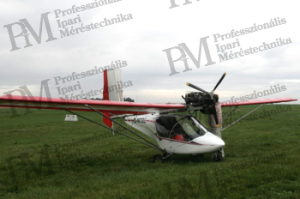
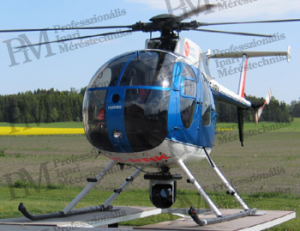
Aerial thermography is suitable to address the mentioned issues. For this task, the most suitable equipment is a thermal camera or camera system with specifically high thermal resolution, high pixel resolution, and fast image acquisition speed mounted on a drone, helicopter, or aircraft. Based on the measurement conditions of the listed tasks, a mid- or long-wave range thermal camera or a camera system covering both ranges should be used. It is crucial that data recording and evaluation are carried out only under the guidance of qualified professionals. Without proper expertise, knowledge of measurement prerequisites, and necessary calculation corrections, data obtained can lead to misinterpretation and misunderstanding.
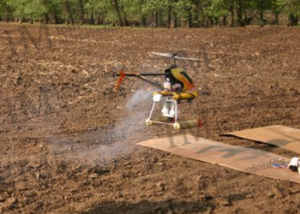

The use of drones is very "trendy" nowadays. In thermography, solutions based on drones are increasingly common, with two current trends observed: the use of high-performance, internal combustion engine or gas turbine single-rotor drones, or the application of significantly lower payload-capacity electric (4, 6, or 8 rotor) drones. While the larger drones can stay airborne for several hours with a payload of 4 to 5 kg, the smaller electric versions can boast about 1 kg payload and half-hour flight time. However, their price is only a tenth of the high-performance internal combustion engine or gas turbine models.
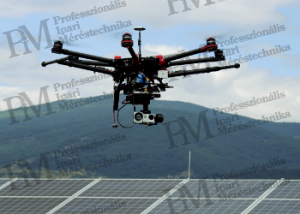
High-resolution thermal cameras with many pixels have good geometric resolution alongside a wide field of view, allowing relatively large solar power plants to be surveyed and documented with an acceptable number of shots. However, cameras with higher pixel count and larger detectors have much higher weight, size, and investment costs. Their use is only feasible with high investment and maintenance cost internal combustion engine or gas turbine drones. In the upcoming issues, we will discuss the aerial thermography assessment of electrical power lines and the examination of large solar systems with drones. Eric Rahne (PIM Ltd.) pim-kft.hu, termokamera.hu
The content of this publication is protected by copyright. Any (even partial) use, electronic or printed republication, is permitted only with proper attribution to the source and author, and with the author's prior written permission. Violation of copyright will result in legal consequences.
Copyright © PIM Professzionális Ipari Méréstechnika Kft.
2026 | Minden jog fenntartva
Impresszum | Adatkezelés